
In this article we look at:
-
- How adjustable cone nozzles and colour-coded fan nozzles differ, and when to use each
- Why spray angle matters for accurate dosing and calibration
- How nozzle angle affects the amount of spray applied to the ground
- Which nozzle angle suits your boom, and how spraying height changes the result
- A simple tip to avoid mixing up your spray tips
Choosing the right backpack sprayer nozzle isn’t just about flow rate. Spray angle plays a big part in how accurately and evenly your product is applied. Here we look at the difference between adjustable cone and colour coded fan nozzles and discuss why getting the angle right is essential for calibration and consistent coverage.
Adjustable cone nozzles
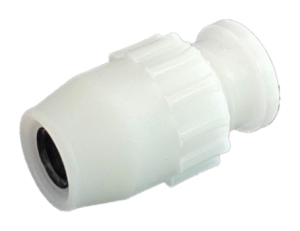
Commonly found on our backpack sprayers, these nozzles produce a variable spray: fully loosened, they produce a jet of spray, and fully tightened, they’ll produce a 70-degree hollow cone pattern. The spray angle will vary as the nozzle is adjusted which causes these nozzles to be less accurate and unsuitable for precision spraying.
However, adjustable cone nozzles offer the advantage of producing a finely atomised spray which is ideal for penetrating into thick foliage, and are fine for spot spraying and other non-precision spray applications.
Colour-coded fan nozzles
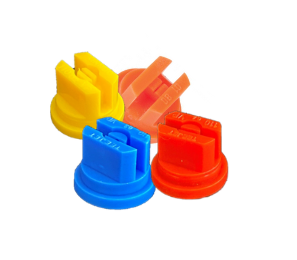
To achieve accurate doses of spray, colour-coded fan nozzles are the most suitable choice. They have a fixed flow rate for any given pressure and come in different spray angles with the most common ones being 80 and 110 degrees. So, for example, a blue spray tip will deliver the same flow rate but might have an 80- or 110-degree spray angle.
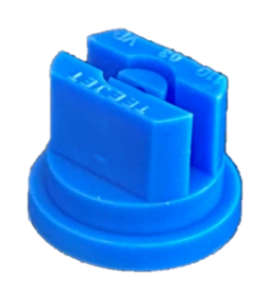
Whilst the colour coding is useful to determine the flow rate of the nozzle, there is no coding for the actual spray angle. The markings on these spray tips are very small and after the nozzle has been used for a while can become almost impossible to read. So, a top tip is to keep your 110-degree tips separate from your 80-degree ones!
Why is spray angle important?
The main objective of any spray applications is to ensure the liquid is delivered accurately to the correct location; the whole purpose of a nozzle is to spread out the spray and shape the fluid distribution to get it where it needs to go. Clearly spray angle is important.
For a wide dispersion, a wider spray angle will be required. Similarly for a narrow dispersion, a narrower spray angle will be needed to keep it contained in a controlled area. It is extremely important to consider spray angle when calibrating and dosing spray applications.
For example, if a green tip is being used and sprayed from a set height of approximately 40 centimetres above the ground, the 80-degree tip will deliver significantly more fluid per square metre than the 110-degree tip will. This is simply because it’s being focused in a more concentrated area.
When it comes to multiple spray booms and multiple nozzles, again, it is important to ensure the spray pattern overlaps across the boom to form a consistent spray and avoid gaps.
Most booms are designed to take 110-degree nozzles. The spacing between the nozzles is such that, at an average distance from the target, means they are going to pull a nicely overlapping, even and consistent spray pattern across the whole boom. However, if the boom was going to be sprayed at a higher height than normal and mounted on a quad, for example, the 80-degree spray nozzle would be more suitable.
The diagram below shows how nozzle height affects overlap.
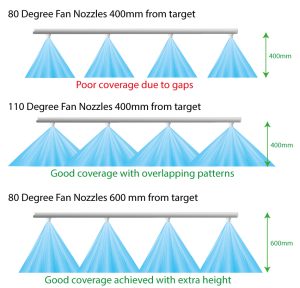
At greater height, the 80-degree pattern will have more time to spread out, resulting in a nicely overlapped pattern.
At a lower height, it will leave gaps in coverage.
These are some of the factors to consider when looking at spray angles and calibration and why spray angle is important in calibrating or dosing. To learn more or to find the best solution for your spraying needs, get in touch at [email protected].